Look at four different sources for Gatlinburg's median sale price this summer and you get four different numbers: roughly $506,000, $600,000, $650,000, and $802,500. That is not a data error. It is the single most important thing a Gatlinburg seller can understand about pricing a cabin here, and almost every out-of-market source misses it.
The Gatlinburg cabin market is small, regulated in ways that flip valuations overnight, and priced far more by a parcel's zoning line and its septic drain field than by its square footage. If you are preparing to list, or you are a buyer running numbers on a listing, the friction that shows up between contract and closing is not random. It is predictable, local, and almost entirely absent from portal estimates.
The Zoning Line That Rewrites Your Valuation
Start here because everything else follows from it. A cabin with a valid Tourist Residency Permit and a documented rental history is a fundamentally different asset from an identical cabin two streets over that cannot legally operate as a short-term rental. The building can be the same. The view can be the same. The price is not.
Short-term rentals are prohibited in Gatlinburg's R-1A (Low-Density Residential) and R-2A (Medium Density Residential) zones. They are permitted in R-1, R-2, R-3, C-1, C-2, tourist commercial, and mixed-use. The Building and Planning Department at 865-436-7792 confirms zoning designations, and this call needs to happen before an offer is signed, not during due diligence. Investors have gone under contract on a "cabin near Gatlinburg" only to discover mid-inspection that the parcel is R-1A and the STR pro forma they were underwriting is invalid.
A separate wrinkle catches out-of-state buyers: properties in unincorporated Sevier County outside Gatlinburg city limits fall under a different system, the county's Short-Term Rental Unit Inspection Program that took effect January 1, 2024. Wears Valley and Cosby cabins commonly get mislabeled as "Gatlinburg" in listing copy. They are not, and their permit path is not the same one.
What the Median Price Isn't Telling You
Here are the numbers a seller sees when they type "Gatlinburg home prices" into a search bar in mid-2026:
| Source | Reported figure | Window |
|---|---|---|
| Zillow ZHVI | $506,638 typical value, down 6.9% YoY | May 2026 |
| Redfin | $600,000 median sale, 62 days on market | 3 months ending May 2026 |
| Movoto | $650,000 median list, 97 days on market | July 2026 |
| Katelyn Warren, Century 21 Legacy | ~$802,500 median sale, +23.6% YoY | Mid-2026 |
The spread is not noise. It is the market. Redfin scores Gatlinburg's competitiveness at 12 out of 100, and in some tracking windows fewer than two dozen homes close in a given month. When roughly 20 sales set a median, one seven-figure luxury cabin sale drags the number hundreds of thousands one direction, and a cluster of $215,000 downtown condo closings drags it back. A seller pricing off a portal average is not pricing off the market. They are pricing off a distribution with almost no mass in the middle.
The practical translation: comparable sales in Gatlinburg carry unusual weight in an appraisal because there are so few of them. A single closed sale on your ridge, at your access grade, with your zoning designation and your permit status, can shift a lender's number by six figures. This is why a comparative market analysis from someone who knows which comps are actually comps matters more here than in a market with 500 monthly closings.
Established resort areas with year-round paved access, such as Chalet Village and Cobbly Nob, tend to hold value more consistently than remote parcels that require four-wheel drive in January. That infrastructure premium is real and shows up in appraisals. So does a documented mountain view, which local pricing patterns suggest can command 30 to 40 percent above equivalent non-view cabins.
The Property Tax Reclassification Nobody Warns Buyers About
A 2021 Tennessee statute, reinforced by subsequent guidance from the State Comptroller's office, allows short-term rentals that hold a business license and are not the owner's principal residence to be reclassified from the 25 percent residential assessment ratio to the 40 percent commercial ratio. That is a 60 percent increase in the taxable share of assessed value, applied annually.
For a seller, this matters two ways. First, if your cabin has been reclassified, the tax bill in your seller disclosure will look larger than a buyer expected based on a comparable "residential" listing down the road. Second, if it has not yet been reclassified but is operating as an STR, a savvy buyer's underwriting will assume the reclassification is coming and reduce their offer accordingly. Getting ahead of this in listing prep, with actual tax figures modeled at both ratios, prevents the mid-negotiation surprise that stalls closings.
Where Cabins Actually Fail Inspection
Standard suburban inspections do not catch what Gatlinburg terrain does to a house. Accu-Spec Inspection Services, which has worked Sevier County cabins since 1993 under Tom Maides, is one of the local shops that treats mountain properties as a separate discipline. The failure modes cluster:
- Septic drain fields on steep, clay-heavy slopes. Dye testing on these systems catches saturation and lateral failure that a visual tank inspection misses entirely. Many hillside cabins rely on private septic because municipal sewer does not extend to their elevation.
- Well capacity that does not match bedroom count. A cabin marketed as sleeping 12 may sit on a well and septic sized for a 1-bedroom load. During a dry summer, that gap becomes a truck delivering water. For an STR buyer, it also becomes a cap on nightly revenue.
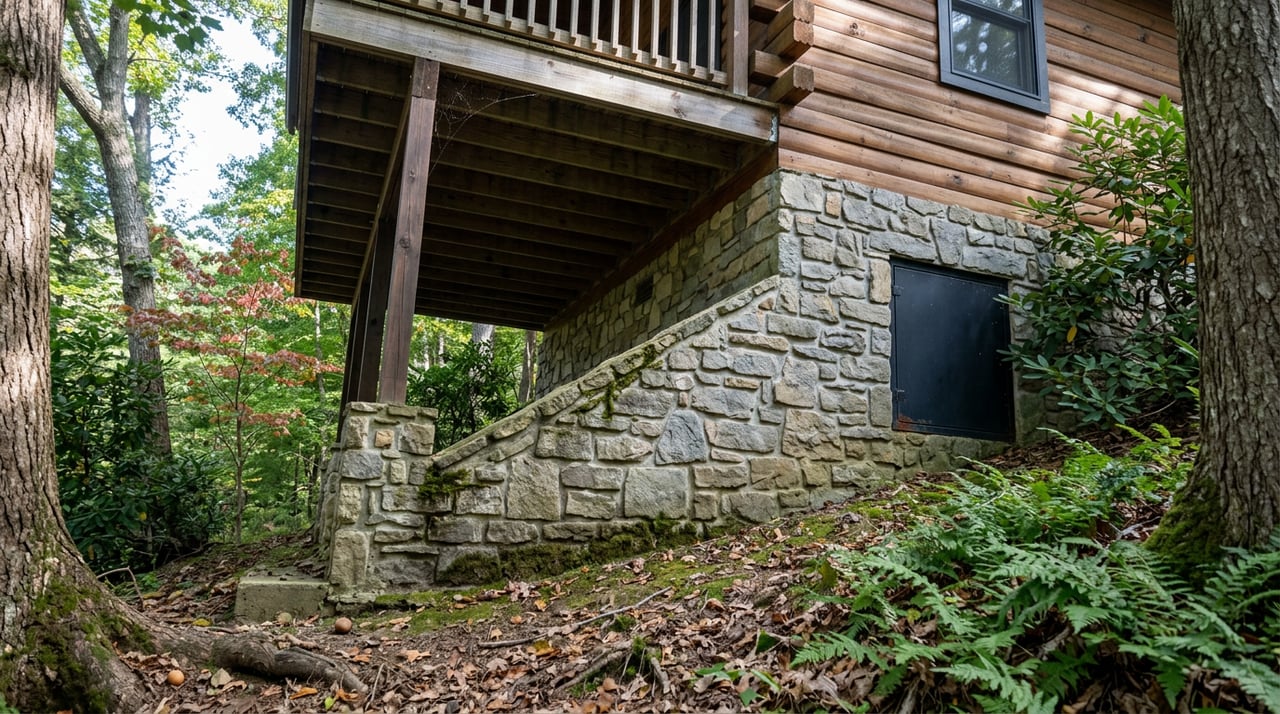
- Deck framing and hillside foundation supports that have shifted with soil movement, moisture, and freeze cycles.
- Crawlspace moisture and roof-water management that failed the last time a heavy August storm came through the ridge.
- Accelerated interior wear on cabins that have run as STRs for several years, particularly HVAC, plumbing fixtures, and any horizontal wood surface exposed to guest traffic.
A pre-listing inspection catches these before a buyer's inspector does. That matters because in a market with 62 to 97 days on the market, a seller who has to renegotiate on septic in week nine is often renegotiating from a weaker position than they realize.
The Permit File Buyers Will Actually Read
If your cabin operates as a short-term rental, the paperwork attached to that permit will be read carefully by any serious buyer's team. The Tourist Residency Permit costs $200 for two-bedroom-or-under units, plus $75 per additional bedroom, renewed annually, and requires an annual fire and building inspection. Properties exceeding three stories, 5,000 square feet, or 12 occupants require an approved sprinkler system, which is a five-figure line item if it has not been installed.
The tax stack sits at roughly 12.75 percent on nightly bookings, combining 7 percent state sales, 2.75 percent Sevier County local sales, and 3 percent Gatlinburg hotel/motel tax. Airbnb collects the 9.75 percent sales portion. VRBO collects none. If your income statements show revenue booked through both platforms, expect the buyer's accountant to reconcile whether the 3 percent lodging tax to Sevier County Trustee was remitted correctly every month. Gaps here have delayed closings.
Sequencing for Sellers
A cleaner listing starts with the file, not the furniture. In practical order:
- Confirm zoning with Gatlinburg Building and Planning at 865-436-7792 in writing.
- Pull the Tourist Residency Permit, most recent fire inspection, and county business license into one folder.
- Reconcile 12 to 24 months of platform statements against tax remittances.
- Model the property tax bill at the 40 percent commercial ratio so buyers see a real number, not a scary hypothetical.
- Order a pre-listing inspection with a firm that has actually worked Sevier County hillside cabins.
- Ask for a comparative market analysis built from cabins that share your zoning designation, access grade, and permit status. Not a ZIP-code median.
The buyer walking into that file is the buyer who closes.
Questions Sellers Ask Late in the Process
Does the Tourist Residency Permit transfer with the sale? No. Permits are tied to the operator, not the parcel. The buyer applies for their own permit and passes their own fire and building inspection before listing. Build that timeline into closing expectations.
If my cabin is in R-1A, is it worthless? It is not worthless. It is a residential cabin, and residential cabins in Gatlinburg have their own buyer pool: primary residents, second-home owners who do not intend to rent, and retirees. The price the STR investor would have paid is off the table. The price the residential buyer will pay is real.
Why does the appraisal keep coming in below list? Because with roughly 20 recent sales in some tracking windows and about 13.4 months of supply reported in mid-2026, thin comp sets and rising inventory both push appraisers toward conservative numbers. The fix is comp selection at listing, not argument after appraisal.
Do I need to disclose the well's summer capacity? Tennessee's disclosure form requires known material defects. If you have hauled water in dry months, that is known. Silence about it invites post-closing litigation. Local counsel handles the specific language.
If you are getting ready to list a Gatlinburg cabin, or you are a buyer trying to underwrite one accurately, the difference between a smooth closing and a stalled one usually comes down to the file assembled before the sign goes in the yard. Jo Schultheiss works these transactions across Sevier County every week and can walk you through what your specific parcel, permit, and comp set actually mean for price. Reach out to start a valuation or line up a pre-listing plan for your cabin.